
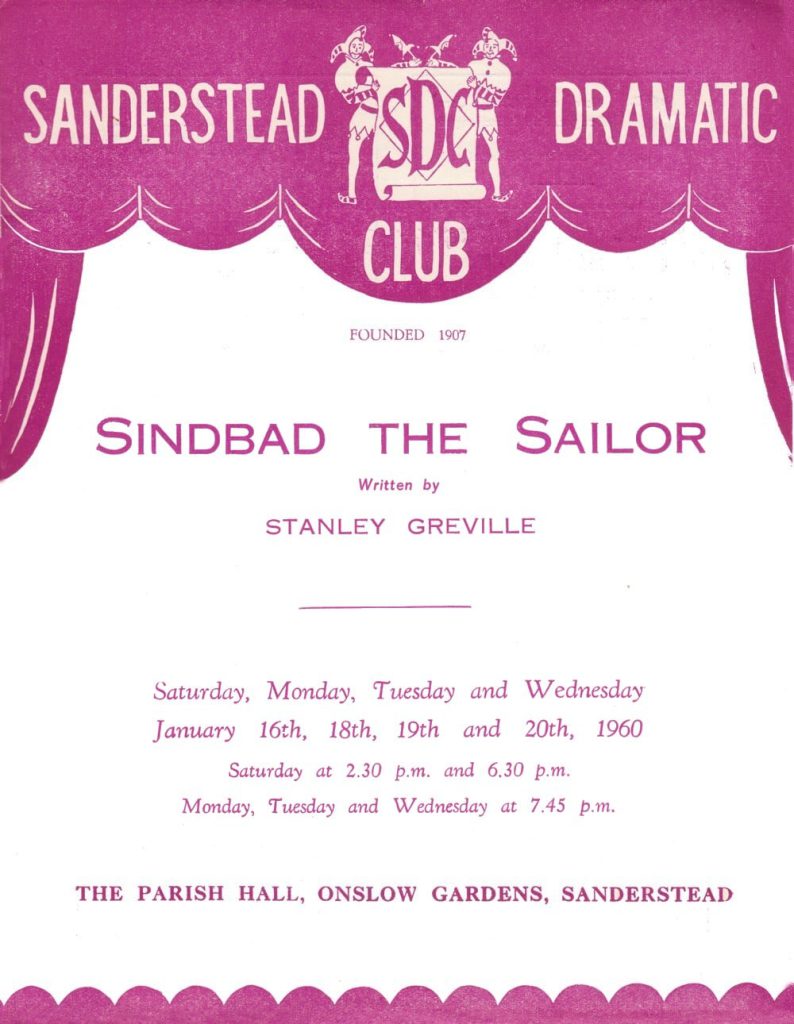
Pantomime 16-20 January 1960 All Saints Church Hall
Sindbad the Sailor
By Stanley Greville. Directed by Nora Herbert
Stanley Greville’s pantomime, staged at the Parish Hall, Onslow Gardens, Sanderstead, on 16, 18, 19 and 20 January 1960, in the club’s fifty-second year (season 1959-60), directed by Nora Herbert. Sindbad sets out from the water front at Bagdad, crosses the desert, sails aboard the good ship Venture and passes through Flotsam and Jetsam and Queen Denizen’s domain to the Island of Sheba and the Sultan’s Palace, ending in Istanbul. The music, arranged and directed by Ancliffe Prince, included “I’ve Loved You”, specially composed by Rowland Hobbs.
Cast & crew
Cast
- Roly
- Peter Simpson
- Poly
- Peter Clements
- Mary
- Mary Sidwell
- Mrs. Pippin
- Harold Herbert
- Captain Corker
- Harold Couch
- Sindbad
- Diana Miles
- Cleo the Camel
- Robin Lilly, Nicholas Critchlow
- Queen Denizen
- Margaret Ibbetson
- Fairy Queen
- Hannah Maughan
- Roha
- Barrie Sidwell
- The Sultan of Sheba
- Alan Winter
Chorus: Villagers, Sailors, Harem Girls and Fairies
Elizabeth Barritt, Penelope Edwards, Genitha Howell, Judith Ibbetson, Avril Milsom, Diana Moulden, Janice Parker, Bernice Saword, Gillian Stone, Pamela Strachan, Jane Taylor, Diana Wooley
Children's Chorus: Children and Sea Sprites
Jane Briggs, Diana Daniels, Rosemary Giusso, Kathryn Inglis, Josephine McHugo, Patricia Rampling, Leslie Tattersall, Christine Trotman
Crew
- Director
- Nora Herbert
- Writer
- Stanley Greville
- Choreographer
- Nancy White
- Choreographer (Children’s dances)
- Peggy Hunter
- Composer (Musical arrangements)
- Ancliffe Prince
- Composer (“I’ve Loved You” specially composed)
- Rowland Hobbs
- Composer (Music, “The Harem-Scarem Kids”)
- Rowland Hobbs
- Composer (Lyric, “The Harem-Scarem Kids”)
- Ancliffe Prince
- Composer (Additional lyrics)
- Alan Winter
- Musical Director
- Ancliffe Prince
- Musician (Violin, Leader)
- Marilyn Hansen
- Musician (Violin)
- Gwendoline Gale, B. Stanton, E. Steele
- Musician (Cello)
- V. Chalder
- Musician (Double Bass)
- Joan Powis
- Musician (Flute)
- R. Lee
- Musician (Clarinet)
- R. Taylor
- Musician (Trumpet)
- W. Hansen
- Musician (Trombone)
- Mary Sims
- Musician (Piano)
- Betty Strevens
- Musician (Timpani, etc.)
- E. Wickenden
- Stage Manager
- J. C. Page
- Assistant Stage Manager
- John Herbert
- Set Design & Painting (Scenic Artist)
- Joan James
- Set Construction (Construction and painting of scenery)
- Members of the Club
- Scenery Manager
- Mr E. V. Peters
- Lighting
- E. Bruce Westwood
- Lighting (Electrician)
- Michael Dossett, Jeremy Stevens, Nigel Clark
- Costumes & Wardrobe (Costume Designer)
- Mollie Ibbetson
- Costumes & Wardrobe (Wardrobe Mistress)
- Mollie Ibbetson
- Costumes & Wardrobe (Dresser)
- Florence Boyer
- Costumes & Wardrobe (Making of costumes and properties)
- Members of the Club
- Make-up
- Ted Howard, Phyl Howard
- Props
- Paul Lyford
- Props (Assistant)
- Shirley Wallace, Mary Grimes
- Front of House Manager
- Rodney Mander
- Box Office
- Pamela Shearing
- Box Office (Assistant)
- George Ives
The Programme
The original programme from the show. Flick through it here, or download a copy to keep.
pages · Souvenir programme
Photos
Filter by person ·
Everyone in these photos ·
Select a name to see their photos
Sindbad the Sailor 1960 Photos
In this photo · people
Select a name to see their profile
· © Sanderstead Dramatic Club
Review
It’s tradition that counts in these pantomimes
Visiting a rehearsal for Sanderstead Dramatic Club’s production of their pantomime, “Sindbad the Sailor,” Frances Dowsett discovers that it’s tradition that counts in these pantomimes.
SANDERSTEAD pantomime enthusiasts with a staunch respect for tradition have just finished another season. They did not present their premiere on Boxing Day, nor did they run their pantomime for two or three months like the West End theatres - but they gave and reaped as much enjoyment as the professional pantomime cat and principal boy.
It was Sanderstead Dramatic Club’s 24th pantomime since their formation in 1908. With a frown and a stern word against the “new-fangled idea of a boy playing a principal boy,” the company kept to the old style and presented “Sindbad the Sailor” - not forgetting that first “d.”
“The great trouble with pantomime today is that it isn’t pantomime at all,” commented the main inspiration of this year’s show, producer Mrs. Nora Herbert. “The original name was ‘Sindbad’ and we kept it to that - none of these ultra-modern West End ideas for us.”
Not for Sanderstead
Too many acrobats while the scene-shifters get into action; too many small men on one-wheel cycles; too many attractive fairies tripping too many unattractive dances; these are the items the club have scorned since its first pantomime in 1930.
“Safeguard the story - forget the ‘flam’,” is their kind of motto. The story is what matters and the supporting items help it on its way, not hindering by diverting attention from the plot.
This is a self-supporting club which can appreciate its talents. Scriptwriters, songwriters, musical directors and choreographers flourish here and pool their talents in the annual pantomime. The script of “Sindbad” was the work of Mr. Stanley Greville, who also wrote “Jack and the Beanstalk” last year for the club. Mr. Alan Winter was given a well-earned rest this year - he has written four pantomimes to date.
I went to their last rehearsal before the show opened at the parish hall, Onslow Gardens, on Saturday, and saw a camel sitting on two chairs. It had two humps, with a boyish head in each, and when it scrambled - amazingly camel-like - to its feet it did a dance in a tray of sand.
Hastily tucking back two inches of green double-knit sweater into its trousers so as not to spoil the camel effect, the rear hump and legs assured me that sand-dancing was hot and difficult.
“Only practice and more practice makes it perfect,” the head in the hump said.
It is an idea like “The Harem-Scarem Kids” which makes the audience look up. If we can have some scenes of singing harem girls, then we can have some toddlers called “The Harem-Scarem Kids” to go with them, thought the pantomime directors. So musical director Mr. Ancliffe Prince got busy and wrote them a song. And the whole production was admirably shown off by Mrs. Joan James’ self-designed, self-painted scenery.
“They have got to be superb to carry on for 24 years, like Sanderstead Dramatic Club.”
Choreographer Mrs. Nancy White, who used to be a dancing teacher, rehearsed in fur boots and a tweed coat to keep out the cold. A member of the 12-strong orchestra wrapped herself in a thick shawl.
“We always manage to have traditional weather for our pantos,” a member remarked wryly. Outside, children were tobogganing.
For many of the members it is quite a family affair. Mrs. Herbert watched critically, with an altern[ate] frown and smile, as her hus[band] played the Dame. Their son, J[ohn], was busy as assistant stage man[ager] […]
“And it is almost a ma[rriage] bureau,” Mr. Herbert told me. “[…] met my wife during one o[f our] shows when she was principal boy and I was the pantomime cat.”
Mr. and Mrs. White were another couple who met as members of the club.
Producing and acting in pantomime must be second nature to the Herberts by now. Sanderstead is by no means the only place which has appreciated them; some years ago, Mr. and Mrs. Herbert introduced this English art to Port of Spain, Trinidad, when they were living there.
On the radio
“But no one knew the meaning of pantomime,” said Mrs. Herbert. “Before we put on our production we had to go on the radio and explain what a pantomime was.”
Whether or not the West Indians fully appreciated an old English custom, they must have enjoyed their introduction to it, because, when the Herberts came home again, Port of Spain was making a regular habit of pantomimes.
A group of people who write, produce, dress and paint scenery for a pantomime year after year cannot fail to attract publicity. They may be able to carry on for five years, perhaps ten, but they have got to be superb to carry on for 24 years, like Sanderstead Dramatic Club.
The producer summed it up like this: “We look forward to presenting an annual pantomime and we get a lot of fun out of it. But it is difficult, especially when we remember the reputation we must keep up year after year.
“We all work hard writing, sewing and directing, but just before the curtain goes up for the first time we get that nagging doubt - is it really as good as last year’s?”
Sanderstead’s ‘Do it yourself’ production
HOW to produce a real pantomime with all the traditional ingredients is an art practised by Sanderstead Dramatic Club for nearly a quarter of a century. During each professional pantomime season they put on their own “Do it yourself” production - aiming to preserve the real meaning of an Old English theatre custom. This week they gave five sell-out performances of “Sindbad the Sailor,” their 14th pantomime since the war - yet another of their self-written, self-designed shows.
Sindbad the Sailor 1960 Review,
